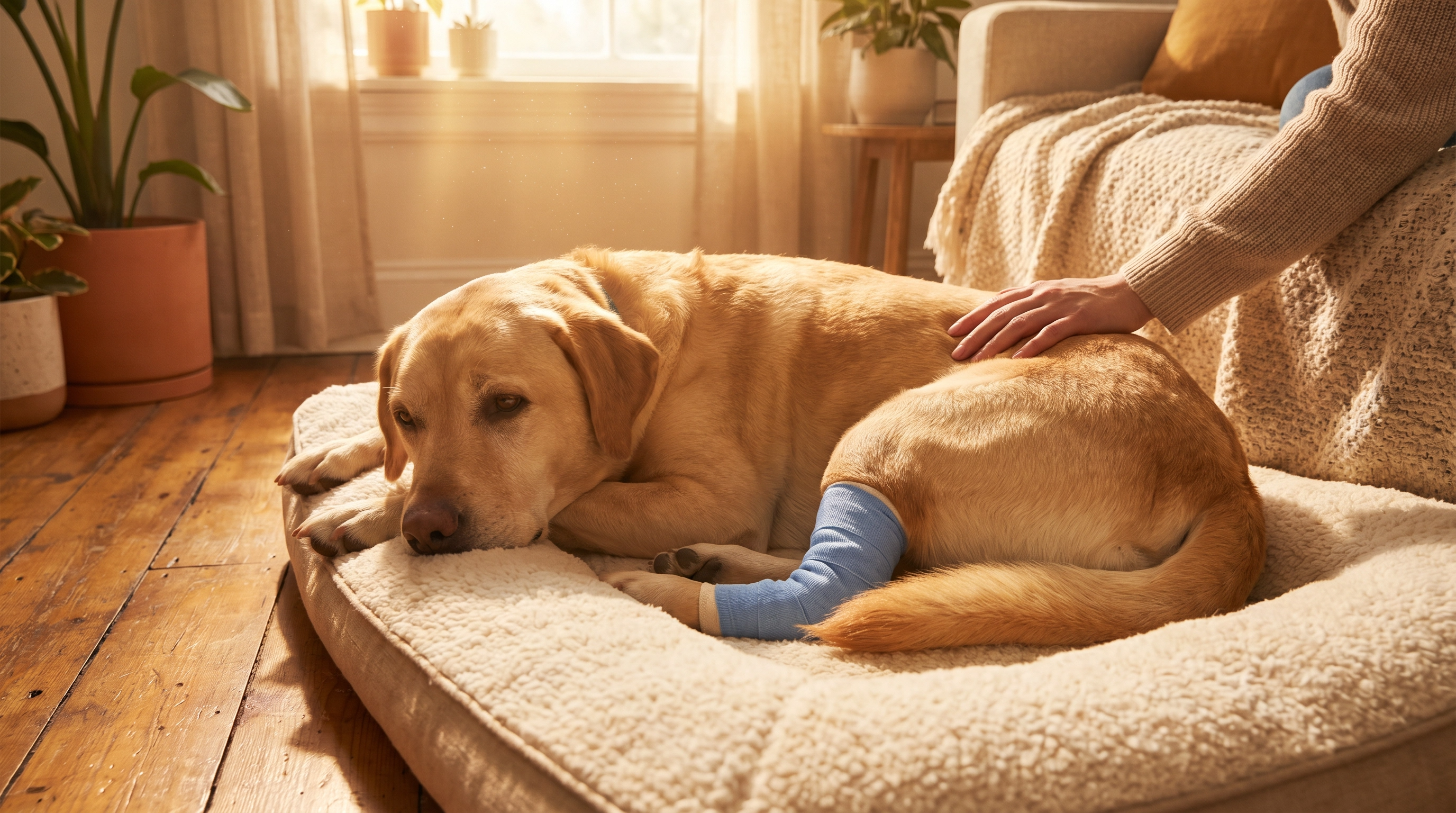
TPLO Recovery, Contralateral Rupture Risk, and Osteoarthritis Management
An evidence-based guide to post-surgical rehabilitation, nutritional interventions, and preventing bilateral cruciate disease in dogs.
Jake Kelly
Pet Longevity Researcher
Abstract
Tibial Plateau Leveling Osteotomy (TPLO) is the standard of care for canine cranial cruciate ligament (CCL) rupture, yielding functional recovery in over 90% of cases. However, osteoarthritis progresses universally post-surgery, and up to 48% of patients experience a contralateral CCL rupture due to compensatory biomechanics and systemic risk factors. This brief synthesizes current veterinary literature on TPLO outcomes, highlighting the critical role of targeted physical rehabilitation and high-dose marine Omega-3 supplementation in mitigating inflammation and preserving lean muscle mass. Furthermore, it examines the controversial link between early gonadectomy and increased CCL rupture risk, providing actionable, evidence-based strategies for owners to optimize recovery and protect the contralateral limb.
1. Key Findings and Clinical Overview
Tibial Plateau Leveling Osteotomy (TPLO) is the gold standard surgical intervention for cranial cruciate ligament (CCL) rupture in dogs, particularly for medium to large breeds and highly active patients. The procedure fundamentally alters the biomechanics of the canine stifle (knee) by leveling the tibial plateau, thereby neutralizing cranial tibial thrust during weight-bearing and rendering the damaged CCL unnecessary for joint stability [1].
While TPLO boasts an overall success rate exceeding 90% for returning dogs to normal or near-normal function, it is not a cure for the underlying joint disease [2]. The veterinary literature clearly demonstrates that osteoarthritis (OA) progresses in all stifles following TPLO, regardless of surgical success [3]. Furthermore, the risk of a contralateral (opposite leg) CCL rupture is exceptionally high, driven by compensatory weight-shifting, underlying anatomical predispositions, and systemic factors such as early neutering and obesity [4] [5].
Successful long-term outcomes depend heavily on a multimodal approach encompassing strict post-operative activity restriction, targeted physical rehabilitation, and aggressive nutritional management to mitigate inflammation and preserve lean muscle mass [6].
2. Data and Statistics: Outcomes and Complications
The long-term prognosis for dogs undergoing TPLO is generally excellent, provided the recovery protocol is strictly followed. However, owners must be prepared for the statistical realities of the procedure and the disease process.
Metric | Statistical Finding | Source |
|---|---|---|
Functional Recovery | >90% of dogs regain normal limb function within 1 year. | SustainableVet [2] |
Return to Sport | 65% of agility dogs return to competition; 80% of those do so within 9 months. | Heidorn et al., JAVMA (2018) [7] |
Contralateral Rupture Risk | 48% of dogs will experience a CCL rupture in the opposite leg. | Barros et al. (2018) [4] |
Timing of Second Tear | 30–50% of contralateral tears occur within 2–5 years; ~30% within 12 months. | SustainableVet [2], TPLO Nashville [8] |
Complication Rate | 15–34% overall complication rate (infection, seroma, implant issues). | DVM360 [9] |
Revision Surgery | 5–9% of cases require a second surgery to address complications. | DVM360 [9] |
Implant Failure | 5–10% of cases experience implant loosening or failure. | SustainableVet [2] |
Osteoarthritis Progression
A landmark 2020 study by Shimada et al. evaluated the long-term progression of OA following TPLO. The researchers found that while peak vertical force (weight-bearing capacity) significantly improved within 6 months and was maintained for up to 36 months, radiographic OA progressed in all patients [3].
"Although OA progressed over time after TPLO, the progression was more gradual in stifles with partial tears than in those with complete rupture. Canine patients would benefit from earlier surgical intervention through development of technology that enables early detection of ligament degeneration." — Shimada et al., Journal of Veterinary Medical Science [3]
3. The Contralateral Rupture Risk: Prevention and Anatomy
The high incidence of bilateral CCL disease—approaching 50%—is a primary concern for pet owners. When a dog ruptures one CCL, they instinctively shift their weight to the healthy leg. This compensatory offloading dramatically increases the mechanical stress on the contralateral stifle, accelerating ligament wear and tear [2].
Anatomical Risk Factors
The tibial plateau angle (TPA) is a critical anatomical factor. A normal canine TPA ranges from 18° to 25°. Dogs with a steep TPA (greater than 30°) experience significantly higher cranial tibial thrust forces during normal ambulation, placing immense strain on the CCL [10]. TPLO surgery physically cuts and rotates the tibia to reduce the functional TPA to approximately 5°, eliminating this thrust [1]. However, a dog with a steep TPA in one leg almost certainly has a steep TPA in the other, predisposing the contralateral limb to the same mechanical failure.
The Spay/Neuter Controversy
Emerging evidence strongly links the timing of gonadectomy (spaying/neutering) to the risk of CCL rupture. A 2024 study published in PubMed confirmed that neutering before 12 months of age is a significant risk factor for cruciate rupture development [5].
"Neutering before 12 months of age was a significant risk factor for CR development. Sex, neuter status, or status as an athlete was not associated with CR risk." — PubMed (2024) [5]
Furthermore, research by Hart et al. (2016) demonstrated that while intact males have a CCL rupture incidence of less than 1%, males neutered before 6 months of age face a 12.5% incidence rate [11]. The removal of sex hormones prior to the closure of the tibial growth plates alters bone growth, potentially leading to steeper tibial plateau angles and altered joint biomechanics.
4. Post-Surgical Rehabilitation and Nutrition
The immediate post-operative period is characterized by significant muscle atrophy. Dogs can lose 15% to 20% of the rectus femoris muscle mass within the first two weeks following surgery [12]. Counteracting this atrophy and managing joint inflammation are the cornerstones of recovery.
The Standard Recovery Timeline
Weeks 1–2: Strict confinement. Short, controlled leash walks (5–10 minutes) for elimination only. Passive range of motion (PROM) exercises may begin under veterinary guidance [13].
Weeks 3–6: Gradual increase in leash walks (15–20 minutes). Introduction of formal physical therapy, including underwater treadmill (hydrotherapy) to build muscle mass without loading the joint [13].
Weeks 7–12: Progressive return to normal activity. Supervised introduction of stairs and longer walks. Bone healing is typically confirmed via radiographs at 8 weeks [13].
Nutritional Interventions
A 2018 randomized controlled trial by Baltzer et al. in the Journal of the American Veterinary Medical Association highlighted the profound impact of targeted nutrition during TPLO recovery. Dogs fed a therapeutic diet high in protein (31% vs. 21% control) and enriched with Omega-3 fatty acids, combined with physical rehabilitation, showed significantly improved clinical outcomes at 6 months post-surgery [6].
The high protein-to-calorie ratio supports the rebuilding of lean muscle mass lost during the initial atrophy phase. Concurrently, high doses of Eicosapentaenoic Acid (EPA) and Docosahexaenoic Acid (DHA) from marine sources actively suppress the production of pro-inflammatory mediators (such as prostaglandin E2) within the joint capsule [6].
Clinical Note on Omega-3s: The source of Omega-3s is critical. Dogs lack the necessary enzymes to efficiently convert plant-based Alpha-linolenic acid (ALA), found in flaxseed, into the bioavailable EPA and DHA required to reduce joint inflammation. Supplementation must utilize high-quality fish or krill oil, targeting a combined EPA/DHA dosage of 230–370 mg per kg of metabolic body weight ($BW^{0.75}$) daily [6].
5. Emerging Therapies and Debates
The veterinary community continues to debate the efficacy of several adjunctive therapies used during TPLO recovery.
Platelet-Rich Plasma (PRP) and Stem Cells: While heavily marketed, the clinical evidence for intra-articular orthobiologics post-TPLO remains mixed. A 2024 randomized trial in the Journal of Small Animal Practice found no significant difference in limb recovery between dogs receiving PRP versus hyaluronic acid injections [14]. However, stem cell therapy shows promise for mitigating early OA progression in partial tears before full rupture occurs [15].
Photobiomodulation (Cold Laser Therapy): Laser therapy is widely utilized in rehabilitation clinics to stimulate cellular healing and reduce localized pain. Yet, a 2024 study in the American Journal of Veterinary Research found no statistically significant difference in outcomes between laser therapy and control groups following TPLO [16]. Despite this, many practitioners report subjective improvements in patient comfort and wound healing.
TPLO vs. TTA: Tibial Tuberosity Advancement (TTA) is an alternative geometry-modifying surgery. However, long-term comparative studies indicate that TPLO yields superior functional outcomes and lower rates of subsequent meniscal tears compared to TTA [17].
6. Practical Implications for Pet Owners
For owners navigating a TPLO recovery or seeking to protect a contralateral limb, the clinical data dictates a proactive, multi-pronged strategy:
Aggressive Weight Management: Obesity is the single most controllable risk factor for contralateral rupture and accelerated OA. Maintaining a lean Body Condition Score (BCS of 4/9 or 5/9) reduces mechanical load on the stifles.
Targeted EPA/DHA Supplementation: Initiate high-dose, marine-sourced Omega-3 supplementation immediately to alter the inflammatory cascade within the joint.
Professional Rehabilitation: Engage a Certified Canine Rehabilitation Practitioner (CCRP). Modalities like the underwater treadmill safely rebuild the quadriceps and hamstring muscle groups, which act as dynamic stabilizers for the knee.
Hormonal Considerations: For owners of intact puppies, delay spaying or neutering until after orthopedic maturity (12–18 months, depending on breed) to allow for normal growth plate closure and joint development.
Addendum
View this article to learn more about supplementaiton that can help your dog retain muscle mass during the exercise restriction following TPLO surgey.
References
[1] Kim SE, Pozzi A, Kowaleski MP, Lewis DD. Tibial osteotomies for cranial cruciate ligament insufficiency in dogs. Vet Surg. 2008. https://pubmed.ncbi.nlm.nih.gov/18251804/ [2] SustainableVet. Long-Term Outcomes of TPLO Surgery. https://www.sustainablevet.org/blog/long-term-outcomes-of-tplo-surgery [3] Shimada M, et al. Long-term outcome and progression of osteoarthritis in uncomplicated cases of cranial cruciate ligament rupture treated by tibial plateau leveling osteotomy in dogs. J Vet Med Sci. 2020. https://pmc.ncbi.nlm.nih.gov/articles/PMC7399324/ [4] Barros LP, et al. Prospective clinical assessment of tibial tuberosity advancement... Acta Cir Bras. 2018. https://www.scielo.br/j/acb/a/QW5L3WTWdJNx4qZGRQrxwhG/ [5] Age of neutering contributes to risk of cruciate ligament rupture in dogs. PubMed. 2024. https://pubmed.ncbi.nlm.nih.gov/39383890/ [6] Baltzer WI, et al. Evaluation of the clinical effects of diet and physical rehabilitation in dogs following tibial plateau leveling osteotomy. JAVMA. 2018. https://avmajournals.avma.org/view/journals/javma/252/6/javma.252.6.686.xml [7] Heidorn SN, et al. Rate of return to agility competition for dogs with cranial cruciate ligament rupture... JAVMA. 2018. https://avmajournals.avma.org/view/journals/javma/253/11/javma.253.11.1439.xml [8] TPLO Nashville. TPLO Literature & Studies. https://tplonashville.com/tplo-literature/ [9] DVM360. Tibial plateau leveling osteotomy--is it really more effective... https://www.dvm360.com/view/tibial-plateau-leveling-osteotomy-it-really-more-effective-proceedings [10] Today's Veterinary Practice. How and Why to Measure Tibial Plateau Angle. https://todaysveterinarypractice.com/orthopedics/small-animal-cruciate-disease-tibial-plateau-angle/ [11] Hart BL, et al. Neutering of German Shepherd Dogs: associated joint disorders, cancers and urinary incontinence. Vet Med Sci. 2016. https://onlinelibrary.wiley.com/doi/pdf/10.1002/vms3.34 [12] Sellon DC, et al. Most agility dogs with cranial cruciate ligament rupture return... JAVMA. 2025. https://avmajournals.avma.org/view/journals/javma/263/7/javma.24.12.0767.xml [13] Animal Outpatient Surgery. From Surgery to Sprint: TPLO Recovery Timeline. https://animaloutpatientsurgery.com/blog/from-surgery-to-sprint-tplo-recovery-timeline/ [14] Effect of intra-articular platelet-rich plasma or hyaluronic acid on limb function recovery... JSAP. 2024. https://onlinelibrary.wiley.com/doi/10.1111/jsap.13704 [15] Canapp SO Jr, et al. Partial Cranial Cruciate Ligament Tears Treated with Stem Cell Therapy. Front Vet Sci. 2016. https://pmc.ncbi.nlm.nih.gov/articles/PMC5155010/ [16] Photobiomodulation therapy in dogs undergoing TPLO... AJVR. 2024. https://avmajournals.avma.org/view/journals/ajvr/85/2/ajvr.23.06.0138.xml [17] Christopher SA, et al. Comparison of long-term outcomes associated with three surgical techniques... Vet Surg. 2013. https://pubmed.ncbi.nlm.nih.gov/23432511/