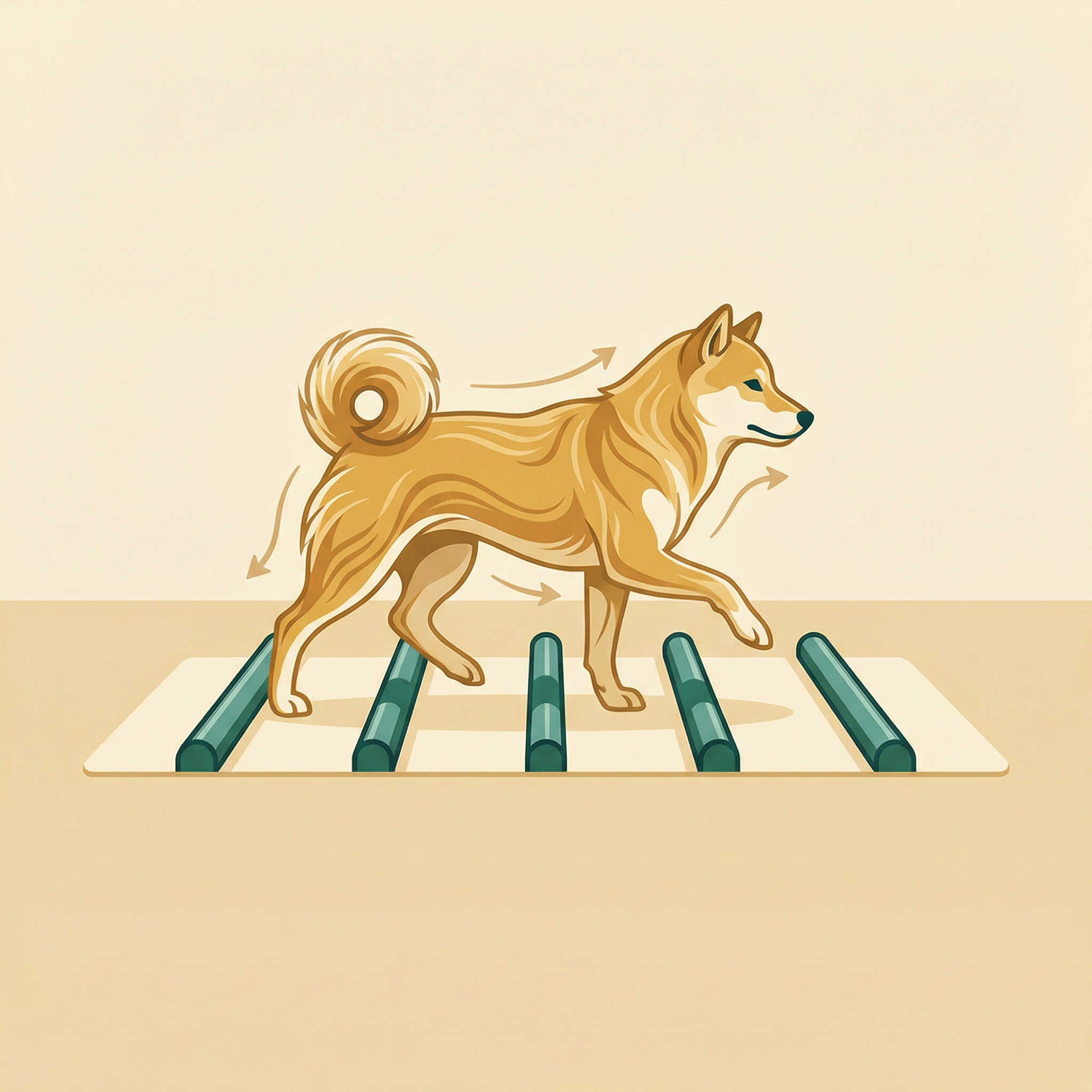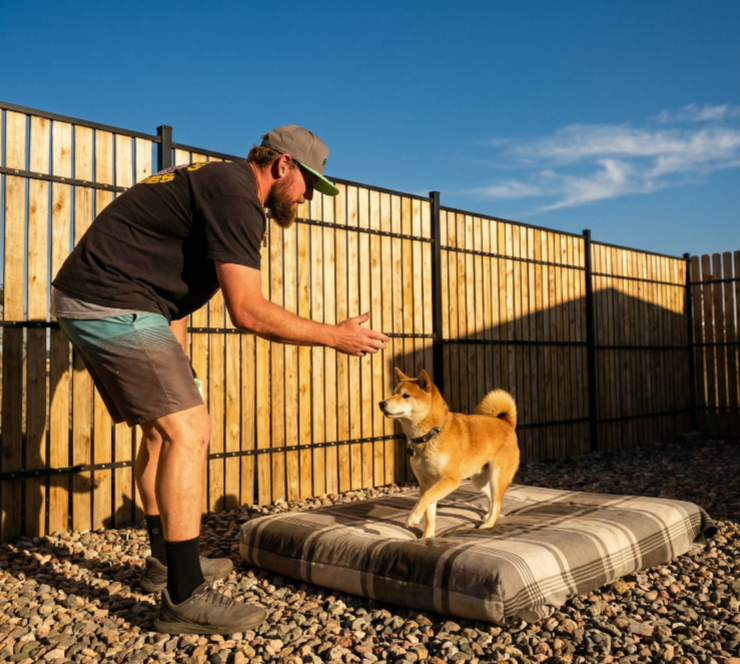
Mattress Walking as Canine Physical Therapy & Strength Training: A Scientific Breakdown
Jake Kelly
Pet Longevity Researcher
Subject: Kado — Canine Unstable Surface Locomotion Protocol
Modality: Compliant/Deformable Surface Walking (Mattress)
Classification: Proprioceptive Neuromuscular Training + Resistance Strengthening
When Kado walks across a mattress, he is not simply taking a stroll on a soft surface. He is performing a multi-system neuromuscular challenge that simultaneously recruits proprioceptive pathways, increases the metabolic demand of locomotion, forces active postural stabilization, and drives greater muscle fiber recruitment than walking on firm ground. This is the same scientific rationale underlying the use of foam pads, wobble boards, balance discs, and underwater treadmills in formal veterinary rehabilitation — the mattress is simply the most accessible, low-cost version of the same intervention.
Mechanism 1: Proprioceptive Overload and Mechanoreceptor Activation
The foundation of this modality is proprioception — the body's ability to sense its own position in space and generate corrective motor responses. This system relies on three classes of peripheral mechanoreceptors embedded in the joints, tendons, and muscles:
Muscle spindles (Ia and II afferents): Detect changes in muscle length and rate of stretch. On a deformable surface, every step produces unpredictable, multi-directional micro-perturbations to limb position, continuously activating spindle afferents and triggering rapid, reflexive corrective contractions throughout the kinetic chain.
Golgi Tendon Organs (Ib afferents): Detect changes in muscle tension. The increased muscular effort required to propel through a compliant surface elevates tendon tension, providing continuous GTO feedback that fine-tunes motor output and prevents overloading.
Cutaneous mechanoreceptors (Meissner's corpuscles, Pacinian corpuscles, Ruffini endings): Located in the paw pads, these receptors detect pressure distribution, surface texture, and vibration. A deformable surface creates constantly shifting pressure gradients across the paw, generating a rich stream of afferent sensory information that is processed in the somatosensory cortex and cerebellum to refine balance and gait.
The net effect is a dramatically amplified afferent sensory signal compared to walking on a stable surface. This forces the central nervous system — the spinal cord, cerebellum, and motor cortex — to process and respond to a far more complex proprioceptive environment, effectively "training" the neural circuitry responsible for balance and coordination. This is the same principle exploited in human physical therapy with BOSU balls, foam pads, and balance boards.
The 2026 Lutonsky et al. study (Animals, DOI: 10.3390/ani16030397) provided the first objective kinematic evidence of this adaptation in dogs. Using a pressure-sensitive walkway, they measured paw center of pressure (pCOP) metrics as healthy dogs walked and trotted across surfaces of increasing compliance (rubber mat → yoga mats of 0.5, 0.8, and 1.0 cm thickness). They found that pCOP radius, craniocaudal displacement, and mediolateral displacement all decreased significantly as surface compliance increased. This reduction in pCOP excursion is not a sign of reduced effort — it is the signature of active postural stabilization: the dog's neuromuscular system is working harder to control and constrain limb movement, actively recruiting stabilizing muscles to maintain balance on the unpredictable surface.
Mechanism 2: Increased Muscle Activation (The EMG Evidence)
The most direct evidence for the strengthening effect of unstable surface training comes from surface electromyography (sEMG) studies, which directly measure the electrical activity — and therefore the recruitment — of specific muscles during exercise.
McLean, Millis & Levine (2019) (Frontiers in Veterinary Science, DOI: 10.3389/fvets.2019.00211) conducted the landmark canine sEMG study, measuring activation of three critical hindlimb muscles — the Vastus Lateralis (VL) (quadriceps; stifle extension), the Biceps Femoris (BF) (hamstring; hip extension, stifle flexion), and the Gluteus Medius (GM) (hip abductor; pelvic stabilization) — across a battery of therapeutic exercises. Key findings directly relevant to mattress walking:
Standing on a wobble board produced significantly higher mean EMG amplitude of the Gluteus Medius compared to stance (p < 0.05). The GM is the primary pelvic stabilizer and one of the first muscles to atrophy in aging dogs with hip dysfunction.
All dynamic exercises produced significantly higher BF activation than stance, with the largest increases during exercises that challenged balance and weight-shifting.
The authors concluded: "Compared to stance, the majority of therapeutic exercises examined increased muscle activity to varying degrees in the BF, VL, and GM." They explicitly recommended these findings to guide clinicians in selecting exercises to target specific muscles during conditioning, strengthening, and rehabilitation.
A mattress walk combines the proprioceptive challenge of a wobble board with the dynamic, full-gait-cycle muscle recruitment of walking — making it a superior combined stimulus compared to static balance exercises alone.
Ramos, Otto et al. (2025) (Veterinary and Comparative Orthopaedics and Traumatology, DOI: 10.1055/a-2693-9061) specifically evaluated the effects of progressively unstable equipment on standing postural control and muscle activity in dogs. Their EMG data confirmed that unstable platforms required greater spinal stability and neuromuscular co-contraction than stable surfaces, with direct implications for canine rehabilitation and fitness training.
Mechanism 3: Resistance Loading and Anti-Sarcopenic Effect
A mattress is not just neurologically challenging — it is physically harder to walk on. The deformable surface absorbs and dissipates energy with each footfall, meaning the dog cannot benefit from the elastic energy return of a firm surface. Every step requires the muscles to generate more propulsive force from scratch.
This is analogous to sand walking or water resistance training in human athletes, both of which are well-established tools for increasing muscular work per stride without increasing speed or impact. The increased metabolic and mechanical demand per step means:
Greater motor unit recruitment: More muscle fibers — including higher-threshold Type II fast-twitch fibers — are recruited to generate the additional propulsive force.
Increased time under tension: The slower, more deliberate gait on a compliant surface extends the duration of each muscular contraction, a key driver of hypertrophic adaptation.
Core and paraspinal co-activation: To maintain a stable trunk on an unstable surface, the deep paraspinal muscles, iliopsoas, and abdominal musculature must co-contract continuously throughout the gait cycle — a form of core strengthening that flat-ground walking does not adequately stimulate.
This resistance component is particularly critical for combating sarcopenia — the age-related loss of skeletal muscle mass and function that is one of the primary drivers of frailty and reduced lifespan in senior dogs. The 2022 Frye et al. geriatric rehabilitation review (Frontiers in Veterinary Science, DOI: 10.3389/fvets.2022.842458) explicitly identified resistance-based therapeutic exercise as a frontline intervention for sarcopenia in aging dogs, noting the strong parallels with human geriatric medicine.
Mechanism 4: Proprioceptive Training Produces Lasting Neural Adaptation
The benefits of this modality are not limited to the session itself. Repeated proprioceptive challenge drives neuroplastic adaptation — structural and functional changes in the neural circuits governing balance and motor control.
Lutonsky et al. (2025) (Frontiers in Veterinary Science, DOI: 10.3389/fvets.2025.1645875) conducted the first randomized, controlled trial of a proprioceptive training program in dogs. After just 4 weeks of training on a motorized proprioceptive platform, the training group showed:
Statistically significant reductions in craniocaudal (CCD%) and mediolateral (MLD%) center of pressure displacement during challenging postural conditions (perturbed and sloped standing).
Large effect sizes (Cohen's d > 0.8) for all significantly improved parameters — a magnitude of effect that is considered clinically meaningful.
Zero significant changes in the control group, confirming the improvements were training-specific, not due to familiarization.
The authors concluded that proprioceptive training produces measurable, lasting improvements in postural stability, particularly under biomechanically challenging conditions — exactly the conditions that predict fall risk, injury susceptibility, and functional decline in aging dogs.
Mechanism 5: Joint-Protective Loading
A critical advantage of mattress walking over conventional exercise is its joint-protective profile. The 2026 Lutonsky pCOP study found that vertical ground reaction forces (vGRF) were largely unaffected by surface compliance — meaning the total compressive load transmitted through the joints does not increase on a soft surface. The neuromuscular challenge and resistance loading are achieved through altered paw mechanics and increased muscular co-contraction, not through increased impact forces.
This makes mattress walking an ideal modality for dogs with:
Osteoarthritis (hip, elbow, stifle, spine)
Post-surgical rehabilitation (TPLO, FHO, spinal surgery)
Intervertebral disc disease (IVDD) recovery
Degenerative myelopathy — where proprioceptive re-education is the primary therapeutic goal
The soft surface provides the neuromuscular stimulus while sparing the articular cartilage from the additional impact that would accompany equivalent muscular loading on hard ground.
Clinical Applications and Who Benefits Most
Population | Primary Benefit | Mechanism |
|---|---|---|
Senior dogs (7+ years) | Anti-sarcopenic resistance training; fall prevention | Increased motor unit recruitment; proprioceptive re-education |
Post-surgical patients | Neuromuscular re-education; muscle mass recovery | Afferent sensory stimulation; graded resistance loading |
Dogs with OA | Pain-free strengthening; joint stability | Muscle co-contraction without increased joint impact |
Dogs with IVDD / DM | Proprioceptive pathway re-training | Mechanoreceptor stimulation; spinal circuit activation |
Athletic/performance dogs | Core stability; injury prevention | Paraspinal and stabilizer co-activation |
Obese dogs | Low-impact calorie expenditure; muscle preservation | Increased metabolic demand per stride |
How to Optimize the Protocol
Surface: A standard mattress (as shown in the video) is excellent. A firmer mattress provides more resistance; a softer mattress provides more proprioceptive challenge. Both are valid. Folded blankets, yoga mats stacked 2–3 deep, or a dedicated foam balance pad (FitPAWS, Klimb) are equivalent alternatives.
Duration and Frequency: Start with 3–5 minutes per session, 3–5 times per week. Progress by 1–2 minutes per week as conditioning improves. For a senior dog, 10–15 minutes of mattress walking is a meaningful, evidence-based workout.
Progressions: To increase the challenge over time:
Incline the mattress (place one end on a step) to increase hindlimb loading — the most important muscle group for mobility preservation.
Add directional changes — walking in figure-8 patterns or lateral stepping challenges the frontal plane stabilizers (GM, adductors) more than straight-line walking.
Slow the pace — a slower, more deliberate walk increases time under tension and proprioceptive demand per step.
Combine with cavaletti poles laid on top of the mattress to add a stepping/lifting component, which the McLean et al. EMG data showed dramatically increases VL and BF activation.
Monitoring: Watch for signs of fatigue — stumbling, reluctance to continue, excessive panting. These are signals to end the session. The goal is controlled neuromuscular challenge, not exhaustion.
Sources
Lutonsky C, Kohlmann J, Reicher B, et al. Effects of Soft Ground on Paw Center of Pressure Metrics in Dogs During Walk and Trot. Animals. 2026;16(3):397. https://doi.org/10.3390/ani16030397
McLean H, Millis D, Levine D. Surface Electromyography of the Vastus Lateralis, Biceps Femoris, and Gluteus Medius in Dogs During Stance, Walking, Trotting, and Selected Therapeutic Exercises. Frontiers in Veterinary Science. 2019;6:211. https://doi.org/10.3389/fvets.2019.00211
Lutonsky C, Affenzeller N, Aghapour M, et al. Improving postural stability through proprioceptive training in dogs. Frontiers in Veterinary Science. 2025;12:1645875. https://doi.org/10.3389/fvets.2025.1645875
Ramos MT, Otto CM, Richards J, et al. The effect of progressively unstable equipment used in canine fitness and rehabilitation on standing postural control and muscle activity. Veterinary and Comparative Orthopaedics and Traumatology. 2025. https://doi.org/10.1055/a-2693-9061
Frye C, Carr BJ, Lenfest M, Miller A. Canine geriatric rehabilitation: considerations and strategies for assessment, functional scoring, and follow up. Frontiers in Veterinary Science. 2022;9:842458. https://doi.org/10.3389/fvets.2022.842458
Breitfuss K, Franz M, Peham C, et al. Surface electromyography of the vastus lateralis, biceps femoris, and gluteus medius muscle in sound dogs during walking and specific physiotherapeutic exercises. Veterinary Surgery. 2015;44(5):588–595. https://doi.org/10.1111/j.1532-950X.2014.12302.x