Free Download — Lateral Suture & Extracapsular Repair Recovery
No bone cut does not mean no recovery.
The evidence-based lateral suture recovery protocol for protecting the repair, rebuilding the dog, and making more good days possible — written for owners navigating extracapsular repair and CCL surgery recovery.
Send Me the Free Guide →No spam. Just the guide. Unsubscribe anytime.


Free Download — Lateral Suture & Extracapsular Repair Recovery
No bone cut does not mean no recovery.
The evidence-based lateral suture recovery protocol for protecting the repair, rebuilding the dog, and making more good days possible — written for owners navigating extracapsular repair and CCL surgery recovery.
Send Me the Free Guide →No spam. Just the guide. Unsubscribe anytime.
The suture is not a finished knee.
When a surgeon chooses lateral suture — extracapsular repair — instead of a bone-cutting procedure like TPLO, the discharge instructions can sound almost gentle: no osteotomy, a strong suture outside the joint, go home, keep them quiet.
Quiet is not the same as recovered. During CCL surgery recovery:
- The implant has to hold tibial thrust while fibrosis forms. Too much play too soon is how sutures stretch or fail.
- Crate rest still wastes muscle in the surgical leg — and shifts load onto the other CCL.
- Inflammation and early osteoarthritis do not pause because the tibia was left intact.
Owners search “lateral suture vs TPLO” looking for permission to ease up. This guide does the opposite: it treats extracapsular repair as real orthopedic recovery — with a surgeon-first restriction window, a red-flag list, and a plan to rebuild the dog afterward.
What you'll learn inside the lateral suture protocol
I built this while walking Kado through his latest extracapsular repair — after already living a TPLO recovery with him. Same dog. Different surgery. The job is still protecting the repair and getting him back to good days.
Protecting the Repair
Why a lateral suture (extracapsular repair) is a temporary stabilizer, not a finished knee — and how the first weeks decide whether the implant holds while scar tissue takes over.
Restriction Without Guesswork
A surgeon-first map of activity limits after CCL surgery recovery: what “crate rest” actually means, what controlled leash walking is for, and why jumping on the couch is not a small exception.
The Nutritional Intervention
Protein and marine Omega-3 dosing to support muscle and joint inflammation from Day 1 of lateral suture recovery — not after the recheck when atrophy is already underway.
The PT and Hydrotherapy Gates
When physical therapy and hydrotherapy can begin after extracapsular repair: wound healing first, then surgeon or rehab clearance — never a calendar date from a Facebook group.
The Red-Flag Playbook
The post-op signs that mean you should call the surgeon the same day — sudden non-weight-bearing, incision trouble, popping with lameness — written for 2 a.m., not a textbook.
Rebuilding the Dog
How to restore muscle symmetry, weight-bearing confidence, and the opposite CCL after lateral suture surgery — so more good days are possible, not just a quieter crate.
The downloadable guide is the full protocol: restriction phases, nutrition, PT and hydrotherapy gates, and the red-flag checklist — for lateral suture, extracapsular repair, and CCL surgery recovery at home.
Lateral suture and TPLO are different operations. Recovery is still the owner's job.
Search results will tell you extracapsular repair is “for small dogs” and TPLO is “the real surgery.” That framing helps nobody whose dog is already home with a lateral suture. Your surgeon already chose. What you control now is load, muscle, weight, and whether you notice a red flag in time.
If you are comparing procedures before surgery, talk to the surgeon who will operate — not a ranking table. If you already had TPLO, the 48% Rule TPLO guide is the matching protocol. Mixing calendars between bone-cut and no-bone-cut recoveries is how well-meaning owners skip a gate their implant still needed.
Call the surgeon
Signs after lateral suture surgery that are not a wait-and-see
Your clinic's after-hours number beats any guide. These are the extracapsular repair and CCL surgery recovery signs that belong on that call the same day.
- Sudden non-weight-bearing after the dog had been using the surgical leg
- Incision heat, discharge, opening, or spreading redness
- Fever, marked lethargy, or refusal to eat
- A pop or click paired with acute lameness
- Swelling, coldness, or a pale paw below a bandage
- Licking or chewing that damages the incision despite an e-collar or suit
Educational, not a diagnosis. If it feels wrong, call anyway.
I didn't just read the research. I'm walking it again with Kado.
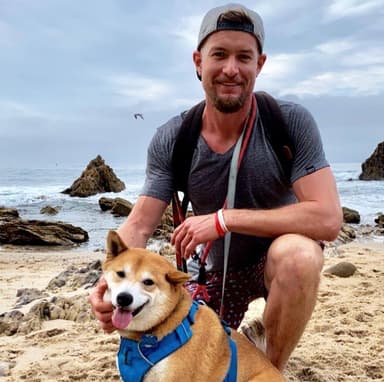
“Kado already taught me what TPLO recovery costs a family. His latest endeavor is lateral suture — extracapsular repair — and I refuse to treat a no-bone-cut CCL surgery as a lesser recovery. Every recommendation in this guide is there to protect the repair, rebuild the dog, and keep more ordinary good days on the calendar. Surgeon first. Then the work we can actually do at home.”
Frequently Asked Questions About Lateral Suture & CCL Surgery Recovery
What is lateral suture surgery for a dog’s CCL tear?
Lateral suture surgery — also called extracapsular repair — is a CCL surgery that stabilizes the knee without cutting bone. The surgeon places a strong suture outside the joint to stand in for the torn cranial cruciate ligament while periarticular scar tissue (fibrosis) develops. That fibrosis is what provides longer-term stability. The implant is not a lifetime mechanical replacement for the ligament; it has to be protected while the body does that work. This guide is written for owners in the middle of that CCL surgery recovery, in owner language, with surgeon instructions always first.
How is lateral suture different from TPLO?
TPLO cuts and rotates the tibia to change how the knee handles load. Lateral suture / extracapsular repair leaves the bone intact and uses a suture implant plus fibrosis to control tibial thrust. That does not make one procedure “easy” and the other “hard.” Both are CCL surgeries. Both require restriction. Both can fail if the dog returns to running and jumping too soon. Surgeons choose based on size, conformation, activity, cost, concurrent injury, and their own outcomes — not a social-media ranking. If your dog had extracapsular repair, this protocol is built for that recovery. If your dog had TPLO, use the companion TPLO guide instead of mixing the two calendars.
How long must a dog be restricted after lateral suture surgery?
Follow your surgeon’s written protocol first. Typical restriction after lateral suture / extracapsular repair is about 8–12 weeks of controlled activity while the suture is protected and fibrosis forms — but the exact timeline, leash length, stairs, and off-leash rules belong to the surgeon who operated, not to a generic blog post. Premature play, jumping, and roughhousing are among the most common ways an extracapsular implant stretches or fails. This guide explains why those weeks feel endless and how to use them without wasting muscle. It does not override a recheck, a radiograph, or a phone call to the clinic.
What signs after lateral suture surgery mean I should call the surgeon?
Call the surgeon the same day for sudden non-weight-bearing after the dog had been using the leg, incision heat/discharge/opening, fever or collapse of appetite, a pop or click with acute lameness, or a swollen, cold, or pale paw below a bandage. Those are not “wait until Monday” signs. Mild day-one grogginess and a toe-touch that slowly improves are different from a dog who was walking and then stops. The red-flag section on this page and in the downloadable guide is a same-day checklist — still call if something feels wrong and is not on the list.
When can physical therapy or hydrotherapy begin after lateral suture surgery?
Two gates, in this order: (1) wound healing — the incision needs to be closed and dry, typically around 10–14 days, and (2) clearance from the surgeon or a certified canine rehabilitation therapist who has seen the dog. Early passive range-of-motion is often prescribed before those gates; that is not the same as hydrotherapy, cavaletti, or a full at-home PT session. Underwater treadmill or swimming usually waits until the incision is sealed and the clinic says yes. Starting PT because a calendar said “week two” is how owners accidentally load a repair that is not ready. The guide maps what is commonly done at each phase after extracapsular repair — always under those two gates.
Recovering from TPLO instead?
The 48% Rule — TPLO Recovery Guide
Bone-cutting CCL surgery has its own 6-phase protocol: atrophy window, nutrition, and protecting the opposite leg.
Also available free
At-Home PT Guide — 25 Exercises
The companion exercise library for after your surgeon clears physical therapy — illustrated, with sets, reps, and a 4-week plan.
Protect the repair. Rebuild the dog.
Get the complete lateral suture / extracapsular repair protocol for CCL surgery recovery delivered to your inbox.
Download the Free Guide Now →We respect your privacy. No spam, just evidence-based pet health. This guide does not replace your veterinary surgeon.
References
- Gordon-Evans WJ, Griffon DJ, Bubb C, Knap KM, Sullivan M, Evans RB. "Comparison of lateral fabellar suture and tibial plateau leveling osteotomy techniques for treatment of dogs with cranial cruciate ligament disease." J Am Vet Med Assoc 243, no. 5 (2013): 675–682.
- Nelson SA, Krotscheck U, Rawlinson J, Todhunter RJ, Zhang Z, Mohammed H. "Long-term functional outcome of tibial plateau leveling osteotomy versus extracapsular repair in a heterogeneous population of dogs." Veterinary Surgery 42, no. 1 (2013): 63–70.
- Christopher SA, Beetem J, Cook JL. "Comparison of long-term outcomes associated with three surgical techniques for treatment of cranial cruciate ligament disease in dogs." Veterinary Surgery 42, no. 3 (2013): 329–334.
- Griffon DJ. "A review of the pathogenesis of canine cranial cruciate ligament disease as a basis for future preventive strategies." Veterinary Surgery 39, no. 4 (2010): 399–409.
- Monk ML, Preston CA, McGowan CM. "Effects of early intensive postoperative physiotherapy on limb function after TPLO." — PMC